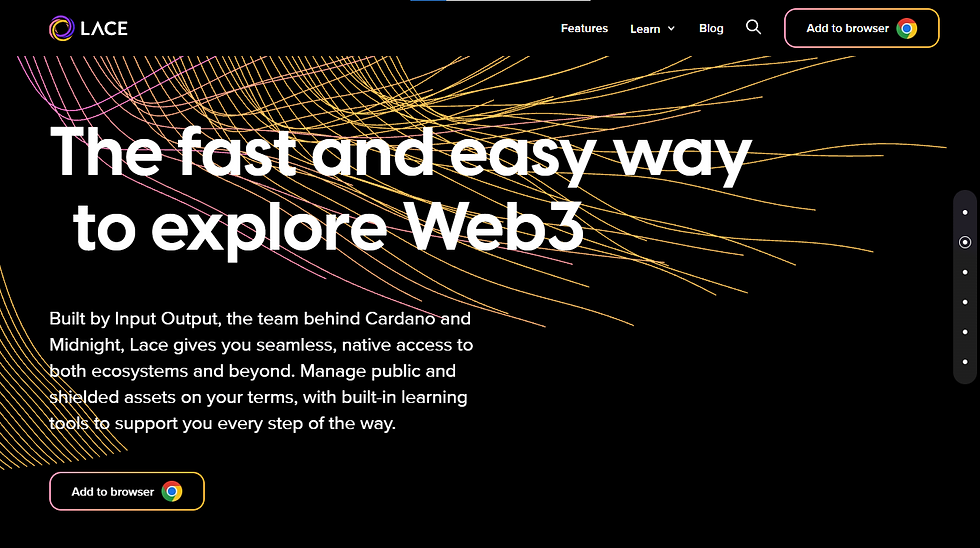
Lace Wallet: A New Standard in Crypto Management
In the rapidly evolving world of Web3, the tools we use to interact with blockchain technology are becoming increasingly sophisticated. Lace Wallet, a light wallet platform built on Cardano, is a leading example of this evolution. Developed by Input Output Global (IOG), Lace is designed to be a simple, secure, and powerful gateway to the decentralized web.
What is Lace Wallet?
Lace is a light wallet. Unlike full-node wallets that download the entire blockchain history, light wallets connect to the network through servers, making them faster and more user-friendly. Lace was created to help users manage digital assets, such as ADA and Cardano native tokens, view NFTs, and connect with Decentralized Applications (DApps) without the complexities often associated with Web3.
The wallet provides a comprehensive suite of features. Users can send and receive assets, participate in staking to earn rewards, and manage their NFT collections. It also includes a DApp connector for seamless interaction with decentralized exchanges, DeFi services, and marketplaces.
Advanced Infrastructure
Lace distinguishes itself through a focus on advanced infrastructure that enhances user experience, security, and control.
1. Multi-Chain and Layer-2 Support
A cornerstone of Lace's evolution is its expansion into a multi-chain wallet. Lace supports not just Cardano but also Bitcoin and the privacy-focused Midnight network, all within a unified interface. This eliminates the need for multiple wallets and provides a holistic view of a user's cross-chain portfolio. The integration of Midnight is particularly notable as it allows users to manage both public and private ("shielded") assets, leveraging zero-knowledge technology for selective disclosure on transactions.
2. Built-In Staking and Multi-Staking
Staking is essential for participating in Cardano's Proof-of-Stake network. Lace simplifies this process, allowing users to delegate their ADA to a stake pool and earn rewards. A more advanced feature is multi-staking, which enables users to delegate their stake to up to five different pools simultaneously, all from a single wallet. This gives users more control to optimize their rewards and contribute to network decentralization.
3. Enhanced Usability Features
Lace incorporates features to improve the user experience. The DApp Explorer allows users to discover and connect to DApps without leaving the wallet interface. The Bundle feature permits users to send multiple types of assets to several recipients in a single transaction, saving on transaction fees and reducing network congestion.
4. Decentralized Identity (Lace ID)
Lace is moving beyond just an asset manager. Lace ID is a coming feature built on Hyperledger Identus that will serve as a privacy-preserving identity layer. It will allow users to create and manage decentralized identifiers (DIDs) and verifiable credentials. This means you can prove your identity or membership without revealing unnecessary personal details, staying in control of your privacy across Web3.
5. Robust Security Framework
Security remains paramount. Lace integrates with hardware wallets like Ledger for added security. The wallet has also undergone an independent security audit by the firm FYEO to verify its code quality and security. For mobile users, a key security consideration is that changing biometric settings (e.g., fingerprint) on the device invalidates the wallet's encryption key, prompting a restore process that ensures only the key holder can regain access.
Advanced Infrastructure FAQs
What is a "light wallet" and why does Lace use this architecture?
A light wallet, like Lace, connects to the Cardano blockchain through intermediary servers rather than downloading the entire blockchain history, which can be hundreds of gigabytes. This makes Lace quick to set up, fast to use, and accessible on mobile devices or browser extensions, perfect for everyday users.
How does Lace's multi-staking feature work?
Multi-staking allows you to delegate your ADA to up to five different stake pools at once. This is done by submitting a single on-chain transaction to move your stake to different keys. It provides more flexibility in choosing pools that align with your preference for saturation, fees, and operational margin, without needing to split your funds across multiple wallets.
How does Lace approach user identity and privacy?
With Lace ID, Lace is building a decentralized identity system. This allows users to prove things about themselves (like a credential or membership) using cryptography, without revealing the underlying data. The user controls what is shared, with whom, and for how long, offering a significant privacy upgrade over traditional Web2 identity methods.
Is my crypto safe with Lace?
Yes. Lace is a non-custodial wallet, meaning you control your private keys and recovery phrase. The software is open-source and has been audited by independent security firms. You also have the option to connect a hardware wallet (like Ledger) for an extra layer of security.
What makes Lace different from other Cardano wallets?
Lace is distinguished by its multi-chain support (Cardano, Bitcoin, Midnight), advanced features like multi-staking and transaction bundling, and a focus on next-generation infrastructure like integrated decentralized identity (Lace ID) and a robust DApp ecosystem, all backed by Input Output Global.
What are swaps in Lace Wallet?
Swaps in Lace allow you to trade one token for another directly within the wallet interface. It connects you to supported third-party decentralized exchanges (DEXs) like Minswap or SundaeSwap. You don't need a separate exchange account; you interact with a DEX via a smart contract, and the new tokens are sent to your wallet after the transaction is confirmed